Most language routines fail for one reason: they ask you to do too much.
You start strong. You set up flashcards. You plan grammar drills. You promise yourself you’ll do 45 minutes a day.
Then real life shows up—work, school, stress, low energy—and the whole thing collapses.
Here’s a calmer alternative:
Read one short thing. Ask a few smart questions. Save a few useful items. Stop.
That’s it.
This is the Read → Ask → Save loop. It’s designed to be:
- short enough to do daily
- structured enough to build momentum
- useful enough to create real “proof of progress”
The goal (so you don’t over-study)
This loop is not about “understanding everything.”
It’s about getting consistent reps:
- you read real sentences in context
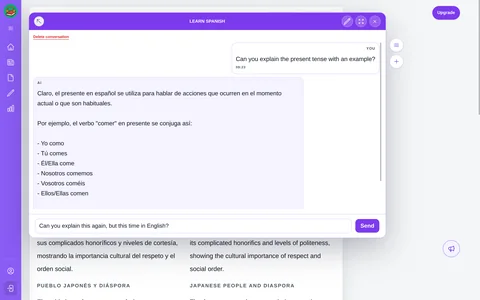
- you get unstuck quickly (without tab-switching)
- you leave with a small set of items worth keeping
If your routine leaves you exhausted, it won’t last. If it leaves you with nothing to reuse, it won’t compound.
This one compounds.
The 15-minute loop (exact steps)
1) Read for gist (7 minutes)
Pick one short article at a level that feels challenging but doable.
Rules:
- don’t translate every line
- don’t stop for every unknown word
- keep moving until you understand the general idea
If you get stuck, mark the sentence and move on.
2) Ask 3 questions (5 minutes)
Ask questions that sharpen comprehension fast.
Copy/paste prompts:
1) What is the main idea of this paragraph in simple English?
2) What does this sentence mean in context? (Give a paraphrase, not a word-by-word translation.)
3) Rewrite this sentence in a more natural way, then give me 2 similar example sentences.
If you only do one thing well in this routine, do this: ask better questions than “what does every word mean?”
3) Save 5 items (3 minutes)
Save exactly:
- 2 words (high frequency)
- 2 phrases (how people actually say it)
- 1 sentence (a complete pattern you want to steal)
This is the “compounding” part. Tomorrow you can review these in 60 seconds.
A printable checklist (use it daily)
- I read 1 short article (for gist, not perfection)
- I asked 3 questions (main idea, paraphrase, rewrite)
- I saved 2 words, 2 phrases, 1 sentence
- I wrote a 3-line micro-journal (below)
The 3-line micro-journal (optional, but powerful)
Write three lines. No more.
- Today I read: (topic + how hard it felt)
- The hardest part was: (one honest friction point)
- One phrase I’ll reuse: (copy it)
This turns “I studied” into “I have evidence.”
The “too busy” version (5 minutes)
If you’re tired or slammed, do the minimum:
- read for 3 minutes
- ask 1 question (main idea)
- save 1 phrase
Five minutes a day beats one intense hour once a week.
The “focused” version (25 minutes)
If you have more time, expand without changing the structure:
- Read (12 minutes): 1–2 articles
- Ask (8 minutes): 5 questions
- Save (5 minutes): 10 items (4 words, 4 phrases, 2 sentences)
Same loop, more reps.
What progress should feel like after 2 weeks
If you do this daily, you’ll notice:
- you stop translating everything
- you can paraphrase faster
- more sentences “feel familiar”
- you start reusing phrases automatically
That’s what sustainable progress looks like: less friction, more flow.
If you want a simple rule: never end with zero
When you’re building a habit, your job isn’t to be heroic.
Your job is to show up enough times that your brain starts expecting it.
Read → Ask → Save is a way to show up without burning out.
If you want to try it inside Devise Learning, start with one short article and run the loop once. Tomorrow, run it again—and review yesterday’s 5 items first.