If you’ve ever had a question ready in your head—but couldn’t get yourself to say it out loud—you’re not alone.
Maybe you worry it’s “too basic.”
Maybe you don’t want to interrupt.
Maybe your mind goes blank the second all eyes (real or imagined) are on you.
And even when people are kind, speaking can still feel like stepping into a spotlight.
When that happens, it’s easy to blame yourself. But this isn’t a character flaw or a lack of effort. It’s a totally human response to pressure: your brain is trying to keep you safe from embarrassment, so it chooses the quiet option—say nothing, avoid the risk.
Over time, that can make practice feel smaller and smaller… until you’re mostly learning alone and hoping confidence will magically appear.
A gentle truth: confidence usually doesn’t arrive first.
It grows because you get steady, low-pressure practice.
That’s where a private AI chat tutor can help—not by forcing you to perform, but by giving you a calm way to keep moving when you feel stuck.
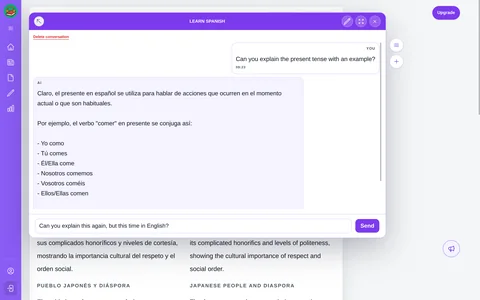
Ask questions privately, right beside the sentence you’re reading.
Why “just speak more” can feel impossible
People mean well when they say, “You just have to practice speaking.” But if you’re a shy learner, speaking isn’t only language—it’s also timing, confidence, and being perceived.
In a live moment you’re trying to:
- find words quickly
- build a correct sentence
- pronounce it well enough
- read the other person’s reaction
- manage the fear of being wrong in public
That’s a lot for anyone. When the pressure spikes, your brain doesn’t choose growth—it chooses protection:
- you freeze
- you second-guess
- you stay quiet
…and then you leave the conversation thinking, Why am I like this?
If that’s familiar: it’s not you being “bad at languages.” It’s you being human.
How a chat tutor helps shy learners
A private chat tutor helps because it removes the part that hurts most: the feeling that you’re being evaluated while you’re still figuring things out.
Think of it as a quiet practice partner that lets you:
1) Ask the “small” questions (without feeling exposed)
The ones you might not say out loud:
“What does this mean in plain language?”
“Is this formal or casual?”
“Why is this word used here?”
“Is my sentence weird?”
You get to be curious without feeling watched.
2) Get help right when you’re stuck (without losing momentum)
When you pause, your momentum is fragile. A chat panel beside your reading keeps you in context.
No switching apps.
No losing your place.
No giving up because it suddenly feels like too much effort.
3) Practice without a microphone (still real practice)
You can practice the thinking that leads to speaking—privately:
- paraphrasing
- rewriting
- creating a reply you could realistically say
- getting gentle correction
- trying again
It’s still language production. It just happens in a calmer environment.
4) Repeat as much as you need (no “I’m wasting someone’s time” feeling)
You can ask the same thing twice. You can try three versions. You can be slow. You can be unsure.
Nothing awkward happens.
A simple, low-pressure routine
This is for days when speaking feels like too much—but you still want to keep progressing.
Step 1 — Read (small and doable)
Choose a short article at your comfort level and read in small bursts.
- Use translation only when a word blocks the meaning
- Try to keep moving, even if you don’t understand everything
Step 2 — Ask one question (the one that unblocks you)
Tap chat and ask one question, like:
- “Can you paraphrase this?”
- “What does this sound like in everyday speech?”
- “Is this sentence polite? Too formal?”
- “What’s a simpler way to say this?”
Step 3 — Try (even imperfectly)
Reply with your best guess. One sentence is enough.
Then ask:
“Correct me and explain the difference.”
Step 4 — Note (one line only)
Write a single line in a journal:
- “Today I learned ___.”
- “A natural way to say ___ is ___.”
- “One sentence I can reuse is ___.”
Read → chat → journal.
Small steps, repeated often, add up.
Common problems the tutor can solve (gently)
If you feel unsure:
- “I think I understand, but I’m not sure.”
Ask for a paraphrase, then write your own summary and compare.
If tone stresses you out:
- “I don’t know if this sounds polite.”
Ask for friendly, formal, and neutral versions so you can feel the differences.
If speaking feels blocked:
- “I can read it, but I can’t say it.”
Ask: “Give me one short sentence I could actually say out loud.”
Then repeat it privately until it feels comfortable.
If responding makes you freeze:
- “I don’t know how to reply fast enough.”
Ask for three options: short / neutral / expressive. Pick the easiest one.
One small truth that helps
You don’t have to become a loud, fearless speaker overnight to learn a language.
You just need a way to practice that feels safe enough to do consistently.
Private practice doesn’t mean you’re avoiding growth.
It means you’re building it in a way that respects where you are right now.